
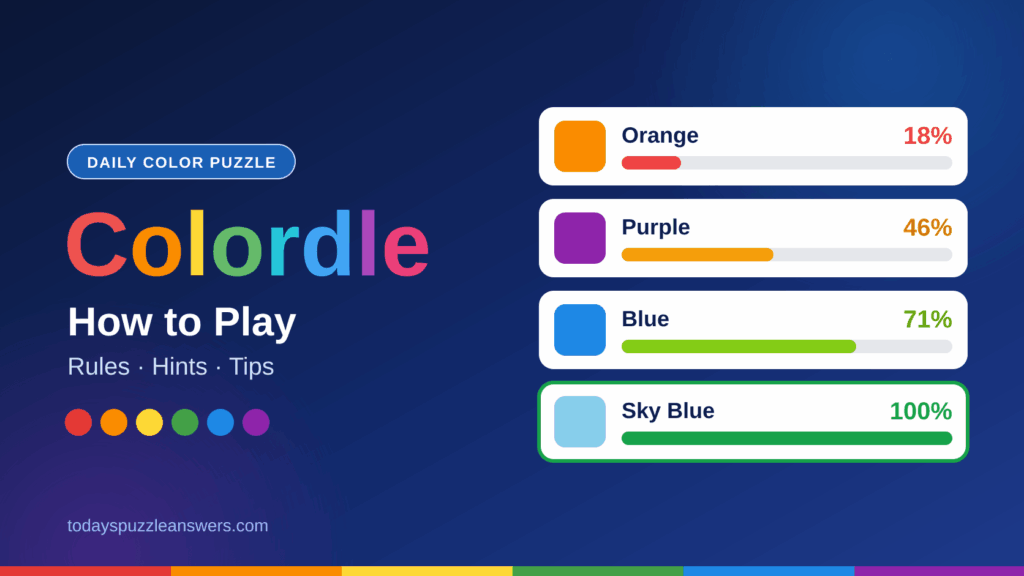
You can picture “burnt orange” or “dusty rose” instantly. Now try the reverse. Someone has hidden one exact color, and all you get is a percentage after every guess. Colordle turns your eye for color into a daily puzzle, and the challenge is that “close” is never quite good enough.
| Red | Orange | Yellow | Green | Blue | Purple |
Instead of letters or word meanings, you work with shades, tones and names. Guess “blue” and you might land at 60%. Guess “navy” and you could jump to 85%. Somewhere between the two is the answer, and your job is to find it.
If you are wondering how to play Colordle or want a smarter way to reach 100%, this guide covers the rules, the scoring, a plain-English look at how screens make color, and the strategies that help most.
You can play Colordle online and start working toward today’s hidden color.
What Is Colordle?
Colordle is a free daily color guessing game created by Ryan Tanenholz. Every day, one color is hidden, and your objective is to work out its exact name by submitting guesses and studying the feedback.
It is often described as a color version of Wordle, but the idea is very different. You are not matching letters or word lengths. You type the name of a color, and the game tells you how close that color is to the hidden one.
The hidden colors are not always the obvious ones. Past answers have included everyday names like honey, watermelon and tortilla alongside more traditional ones like magenta, burnt orange and electric blue. That variety is what keeps the puzzle interesting.
How to Play Colordle
The rules are simple, and you can start in under a minute with no account or download.
|
1
|
Open the game: Visit the official Colordle website in any browser. |
|
2
|
Enter a color name: Type the name of any color you know into the guess box. |
|
3
|
Submit your guess: Press Enter to see how close your color is to the hidden one. |
|
4
|
Read the percentage: A higher percentage means your guess is closer to the answer. |
|
5
|
Use any color clues: The game can also indicate whether the hidden color has more or less red, green or blue than your guess. |
|
6
|
Keep going: Continue guessing until you reach 100% and find the hidden color. |
The key habit is to learn from every result. Even a low score tells you which part of the color spectrum to leave behind.
What Do the Colordle Percentages Mean?
The similarity percentage is the most important feedback in the game. Every guess gets a score showing how near it is to the hidden color. The bars below are examples to show the idea.
| 100% |
You found the hidden color
|
| High scores |
Right family, try a different shade
|
| Medium scores |
In the area, hue or brightness is off
|
| Low scores |
Far away
|
You do not need to memorize a scoring chart. Just remember that higher is better, and use each score to decide whether to stay in a color family or move on.
How Colors Work: RGB and Hex in Plain English
You can play Colordle by name alone, but a little color knowledge makes the clues much easier to use. Screens create every color by mixing three lights: red, green and blue, often shortened to RGB.
| Red 0 to 255 |
Green 0 to 255 |
Blue 0 to 255 |
Each of the three values runs from 0 to 255. Higher numbers mean more of that light. Here is how a few colors look as numbers.
| Red: 255 red, 0 green, 0 blue (#FF0000) | |
| Black: 0, 0, 0, which is no light at all (#000000) | |
| White: 255, 255, 255, which is full light (#FFFFFF) | |
| Grey: red, green and blue are roughly equal, such as 128, 128, 128 (#808080) | |
| Burnt Orange (a past Colordle answer): 204, 85, 0 (#CC5500) | |
| Ash (a past Colordle answer): 190, 186, 167 (#BEBAA7) |
Colors are also written as hex codes such as #FF0000, which is just the same three values in a compact form: two characters each for red, green and blue. So when you learn that the hidden color has more red or less blue than your guess, you can translate that into a shade: more red moves a color warmer, and less blue moves it away from purple and sky tones.
Daily Puzzle and Unlimited Practice
There is more than one way to enjoy Colordle, depending on how much time you have.
Daily Puzzle
A new hidden color arrives every day, at midnight in your own time zone. Everyone gets the same one, which makes it easy to compare progress with friends.
Unlimited Practice
If you finish the daily color and want more, the site also offers an unlimited practice mode. It is a good way to train your eye and learn the names of unfamiliar shades without waiting for tomorrow.
Playing on Your Phone
Colordle runs in a mobile browser and includes an on-screen keyboard, so you can play on a phone or tablet as easily as on a computer.
Best Tips and Strategies for Solving Colordle
Reaching 100% is not about knowing every color name. It is about using the feedback to narrow down the family, then the shade, then the exact name. The swatches below are example shades, and the game’s exact values may differ slightly.
1. Start With Basic Colors
Open with simple, familiar names such as red, blue, green, yellow, purple, orange, pink, brown, grey, black and white. These guesses quickly show you which color family to explore.
| Pink | Brown | Grey | Black | White |
2. Follow Your Highest Percentage
Pay attention to the guess with the best score. If blue clearly beats everything else, stay with blue and test shades like navy, royal blue, sky blue or teal rather than returning to other families.
| Navy | Royal Blue | Sky Blue | Teal |
3. Think in Shades Once You Are Close
When you are stuck at a high percentage, stop guessing broad colors and start guessing specific shades. If you are near green, try olive, emerald, forest green or lime in turn. The last few points usually come from the exact shade, not the family.
| Olive | Emerald | Forest Green | Lime |
4. Test Light and Dark Versions
Words like pale, light, dark, deep and burnt change a color a lot without changing its family. If “blue” scores well, check “light blue” and “dark blue” to learn whether the answer is brighter or deeper.
| Light Blue | Blue | Dark Blue |
5. Do Not Forget Neutrals and Everyday Names
Not every answer is a bright color. Greys, beiges and muted shades appear often, and some answers are named after everyday things such as honey or watermelon. If the usual color names keep scoring low, try neutral and food-inspired names.
| Beige | Ash | Silver | Grey |
6. Use the Red, Green and Blue Clues
If the game tells you the hidden color has more or less red, green or blue, change your next guess in that direction. Warmer, cooler, lighter or darker is usually enough to pick the next name.
7. Save the Hints for Last
If you have tried several color families and the scores are not improving, hints can help. Try to get as far as you can on your own first, because finding the exact shade yourself is the best part of the game.
Colordle vs. Contexto: What Is the Difference?
Both games give you a closeness score instead of a simple right or wrong, but they test completely different skills.
| Colordle | Contexto | |
| Focus | Color, shade and color names | Word meaning and associations |
| Feedback | Similarity percentage, where 100% wins | Ranking, where rank #1 wins |
| Guess limit | No strict limit | No strict limit |
If you like Colordle’s feedback style, try our Contexto guide for a word-based version of the same idea.
Frequently Asked Questions
Is Colordle free to play?
Yes. Colordle is free, with no account, download or payment needed. You just open the website and start guessing.
How many guesses do you get in Colordle?
There is no strict guess limit. You can keep guessing until you reach 100%, so the goal is to get there efficiently, not to beat a counter.
What does the percentage mean in Colordle?
It shows how close your guess is to the hidden color. A higher percentage means a closer match, and 100% means you found it.
Do I need to know hex codes to play?
No. You guess by color name, not by code. Knowing a little about red, green and blue values can help you use the color clues, but it is not required.
Is there a new Colordle color every day?
Yes. A new color is available every day, at midnight in your own time zone.
Can I play Colordle more than once a day?
Yes. In addition to the daily puzzle, the site has an unlimited practice mode for extra rounds.
Can I play Colordle on my phone?
Yes. The game works in any mobile browser and includes an on-screen keyboard.
Who made Colordle?
Colordle was created by Ryan Tanenholz and is available at colordle.ryantanen.com.
What should I do if my percentage stops improving?
Change direction. Try a different color family, test lighter and darker versions of your best guess, or switch to neutral and everyday color names. A fresh angle usually breaks the stall.
Ready to Find Today’s Hidden Color?
Colordle rewards a good eye as much as a good vocabulary. Every guess shows you a little more about the hidden color, and a few smart steps are usually enough to go from a broad family to the exact name.
Head over to the official Colordle game and see how fast you can reach 100%. And for daily hints, answers and guides to your favorite puzzles, visit Today’s Puzzle Answers.